The hub
A katra is per-repository, which is right for the log and wrong for the question “what have I been doing?”. The hub serves every registered katra from one URL.
katra hub serve # http://localhost:4200
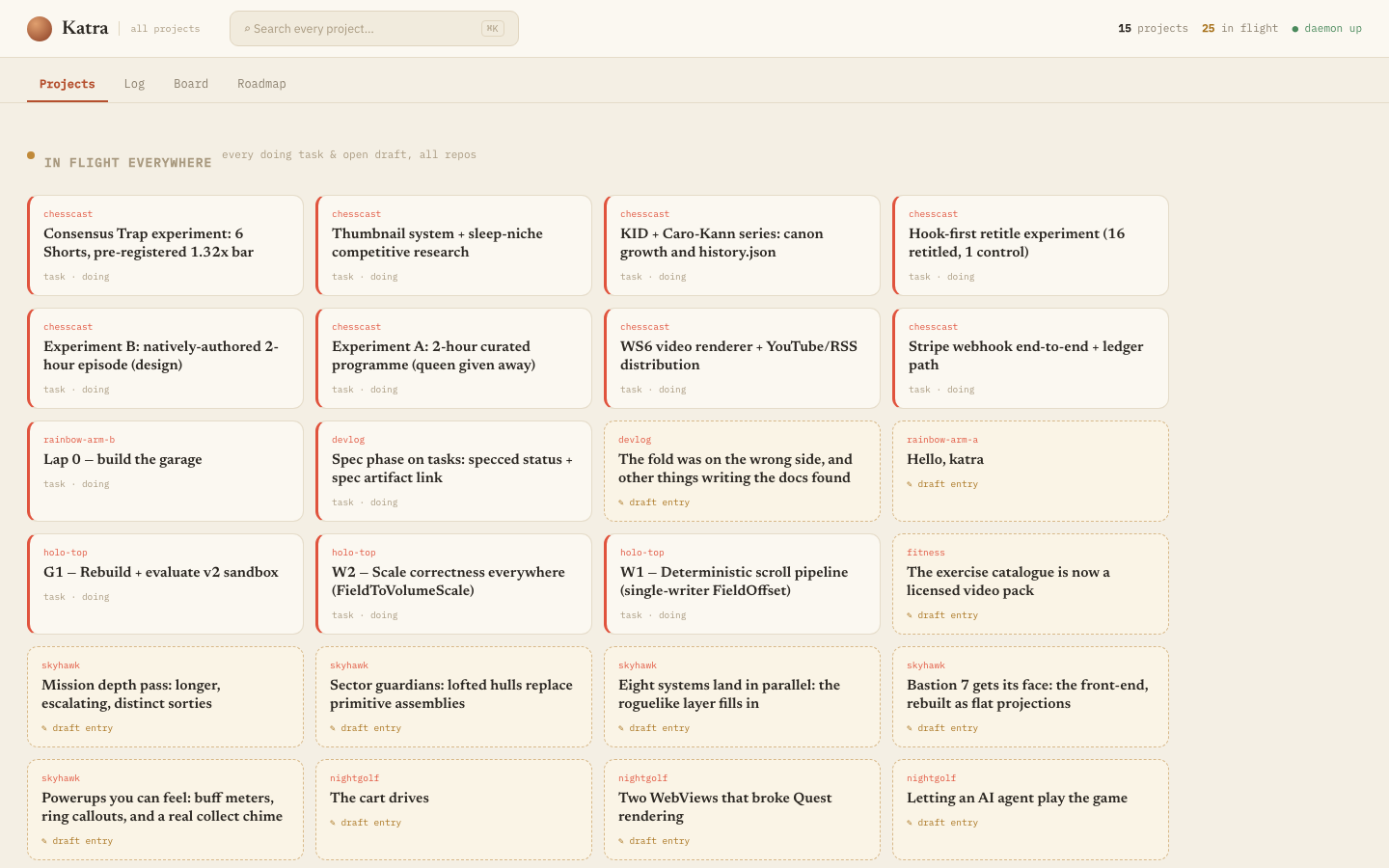
That is the maintainer’s own hub — 14 registered projects, 25 things in flight, none of it re-typed anywhere. Every card is a real task or draft entry still open in its own repository’s katra.
The registry
A machine-global list of store directories at
$XDG_CONFIG_HOME/katra/registry.yml (or ~/.config/katra/registry.yml), so
the hub finds every project without scanning your disk.
projects:
  - /Users/you/work/game/katra
  - /Users/you/work/api/katra
katra init and katra setup register a project automatically. Otherwise:
katra hub scan ~/work      # find and register every katra under a root
katra hub list             # list them, dropping any that no longer exist
hub list prunes as a side effect — an entry whose config.yml has gone is
removed and the file is rewritten. So is a temp directory some other tool
registered and then deleted. Pruning is how the registry stays honest without a
separate garbage-collection step.
KATRA_REGISTRY overrides the path, which is mostly useful for tests.
What it serves
| Path | What |
|---|---|
/ |
The project index — every katra, with its accent, entry count and drafts. |
/board |
A cross-project board: what is in flight everywhere. |
/roadmap |
Tasks and epics across every project. |
/log |
One merged, chronological log. |
/p/<id>/ |
One project’s full viewer, exactly as katra serve renders it. |
/api/hub.json |
A portfolio snapshot as data, for native clients. |
Project ids are derived from the repository name and are stable, so a bookmark
into /p/<id>/ keeps working. A collision gets a numeric suffix.
Livereload is global: a change in any store reloads every open tab.
Running it at login
katra hub install        # macOS: a launchd agent on port 4200
katra hub uninstall
contrib/launchd/com.katra.hub.plist in the repository is the same agent, if
you would rather install it by hand or adapt it for systemd.
The agent runs katra hub serve with KeepAlive, so it restarts if it dies and
starts at login. It resolves katra by absolute path, which means a
rebuild does not change what is running:
make install
launchctl kickstart -k "gui/$(id -u)/com.katra.hub"
The hub re-reads the registry every 10 seconds while it runs, so a katra you create later appears on the board on its own. It did not always: before that, the daemon snapshotted the registry at startup and a project registered after login stayed invisible until the machine was rebooted. If you are on an older build and a new project is missing, that is the bug, and restarting the hub is the workaround.
A registry that is briefly unreadable — caught mid-write — leaves the previous project set in place rather than emptying the board.
The static aggregate
katra build --all --out ./site
One self-contained directory containing every registered katra, with the same index, board, roadmap and per-project views the daemon serves. No external requests, so it hosts anywhere: GitHub Pages, an S3 bucket, a USB stick.
This is the sharing story. There is no hosted service, no account, and no sync — the aggregate is a build artifact you own.
Per-project, without the hub
katra serve from inside a repository serves that one project on port 8080,
with the same viewer. The hub is additive; nothing depends on it, and a project
that is not registered still works completely on its own.