katra
A committed dev log you write as you build — and the memory that makes spec-driven agentic development work.
For a developer, solo or pairing with an agent, who wants the log to hold the why — the approach that failed, the screenshot of the thing working — not a paraphrase of the diff. For an agent implementing from a committed spec, it is where that work gets recorded as it happens, in the same repo the spec lives in, so the next session has something durable to pick up.
Entries are markdown files in your repo. They can embed before/after sliders, galleries, video, callouts and arbitrary self-contained HTML. When you commit, the entry you were writing is stamped with that commit’s hash and diffstat and drops into the log. A live page serves the whole thing on your LAN and reloads as you type.
katra init --install-hook        # store + portable Git auto-stamp
katra new "Reworked the swing"   # start a draft
katra capture shot.png           # drop a screenshot into it
katra serve                      # live page, reloads as you write
git commit -m "…"                # the draft is stamped with this commit
Install Quickstart Source on GitHub
The one idea
A draft is an entry with no commit hash. That is the entire state machine.
It shows up in the In Progress panel the moment you create it — there is no scratch file, no separate document, and no “promote” step. Stamping it adds the hash and the diffstat, which is what moves it into the log. Nothing can get stuck in a buffer you forgot to publish, because there is no buffer.
The corollary is that the log writes itself in the order you actually worked, including the parts that did not pan out — which is the half a squashed commit history always loses.
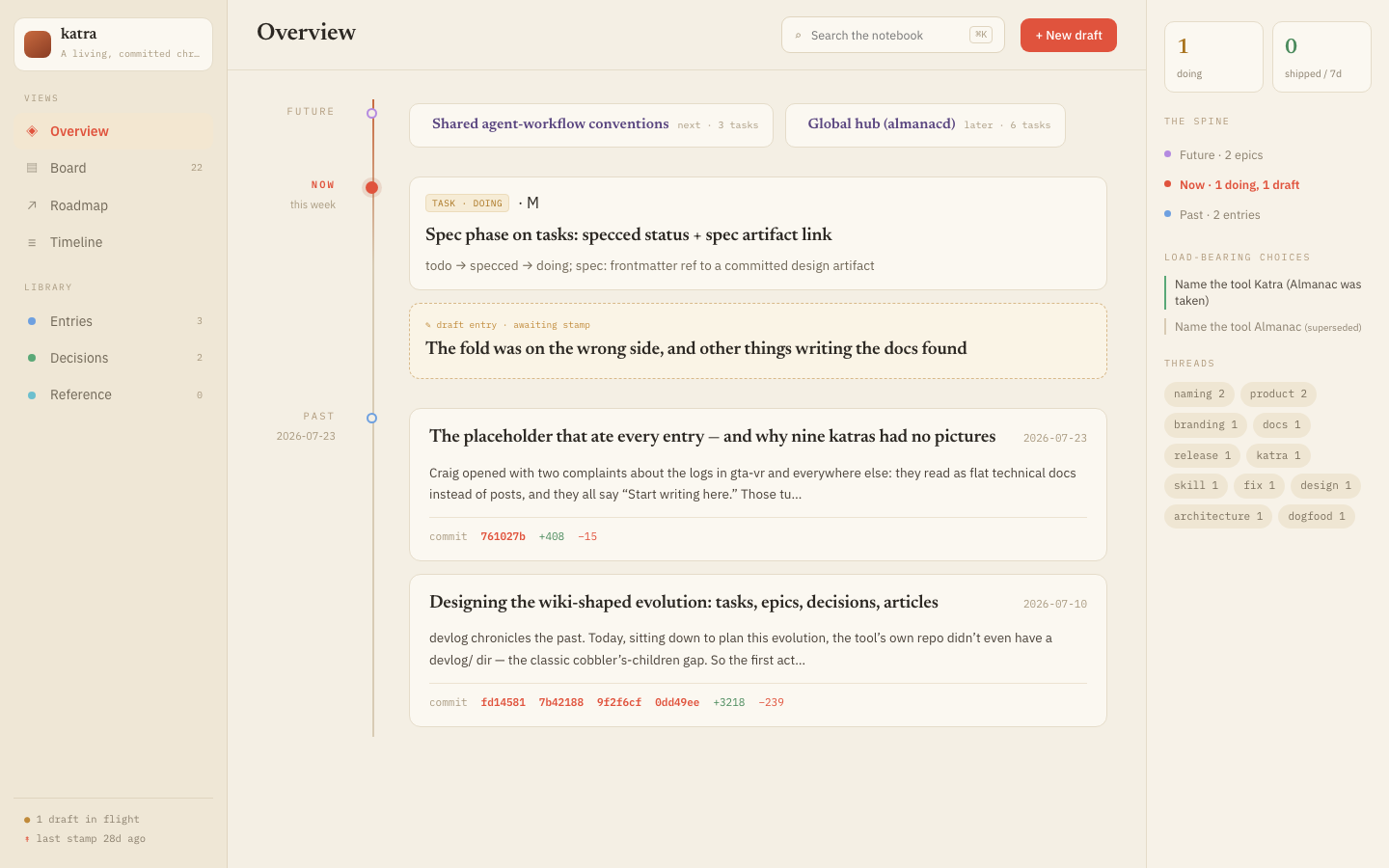
katra serve renders that spine as a live page on your LAN, reloading as you
write — no build step in between.
Where to start
| If you want to | Read |
|---|---|
| Get it running in five minutes | Quickstart |
| Follow the complete spec-to-stamp loop in any coding harness | The Katra workflow |
| See what an entry can contain | Components |
| Look up a command or a flag | CLI reference |
| Change the title, accent, or hook behaviour | Configuration |
| Write a tool that reads a katra | On-disk format |
| Have an agent implement from a committed spec, and keep the log for you | Agents |
| Read every project’s log from one page | The hub |
| Change katra itself | Architecture |
This is Diátaxis-shaped but not Diátaxis-sized: a project this small folds its how-to recipes into the tutorial (Quickstart) and the workflow reference (The Katra workflow, Agents, The hub) rather than maintaining a separate how-to section. Reference (CLI, Configuration, Components, On-disk format) and explanation (Architecture, Design notes) stay split out.
What it is not
- Not a blog engine. There is no theme system, no plugin API, no feed. The static build is a single self-contained directory so you can host it anywhere, and that is the whole publishing story.
- Not a changelog generator. It does not summarize your diff. It exists for the part a diff cannot hold — the reasoning, the alternative you rejected, the screenshot of the thing working.
- Not a service. Nothing is stored anywhere but your repo. Uninstall it and every entry is still a readable markdown file.
License
MIT. Full source at github.com/craigjmidwinter/katra.